Benefits of Custom ERP Systems Over Traditional Software
January 28, 2026 • Noor Ul Sabah
Enterprise Resource Planning (ERP) software has been a pillar of contemporary businesses, as it enables them to operate, handle data, and make decisions through a single system. Not every ERP solution is, however, equally flexible and long-term.
This article coversthe advantages of tailor-made ERP systems as compared to standard software, and it compares software in ERP to shed light on the reasons why tailor-made ERP systems are replacing off-the-shelf systems.
What Are Custom ERP Systems?

Custom ERP Enterprise resource planning systems are custom-made ERP systems that are designed to suit the internal processes, objectives, and operations of a business. The software is business-oriented instead of being made to fit the business.
Such systems enable the organization to only install the features they require, combine the current tools, and expand functionality as the business grows. This renders custom ERP systems suitable for the growing and intricate organizations.
What Is Traditional ERP Software?
Traditional ERP software is the off-the-shelf ERP software that is pre-built and aimed at a wide audience. The common modules that are available on these platforms are finance, HR, inventory,y and CRM.
Although traditional ERP software is easier to install, it is not as customized. Companies will have to adapt to the existing software framework, alter their internal operations, acquire extensions, or tolerate inefficiencies.
Custom ERP Systems vs Traditional Software (ERP Software Comparison)
A comparison of ERP software indicates that the largest disparity isinn the aspect of adaptability. The traditional ERP system emphasizes standardization and the custom ERP system emphasizes alignment to business needs.
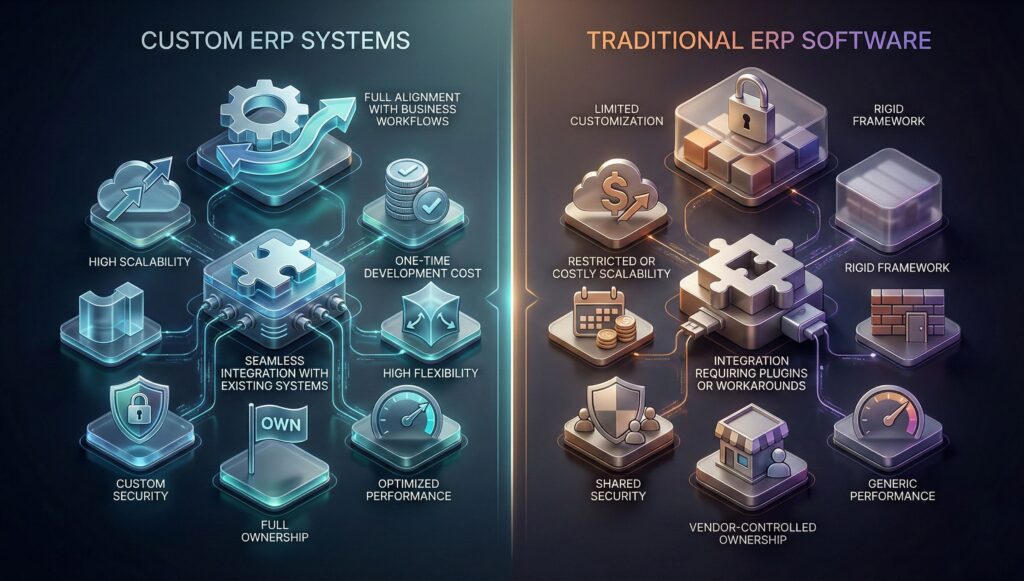
Organizations that have distinct workflows or high growth strategies should use custom ERP systems to have a better level of control, scalability, and long-term performance.
Custom ERP vs Traditional ERP: Comparison Table
| Feature | Custom ERP Systems | Traditional ERP Software |
| Customization | Fully aligned with business workflows | Limited customization options |
| Scalability | Scales easily with business growth | Often restricted or costly |
| Integration | Built to integrate existing systems | Requires plugins or workarounds |
| Cost Structure | One-time development cost | Ongoing licensing fees |
| Flexibility | High flexibility for changes | Rigid framework |
| Security | Custom security and access control | Shared security model |
| Ownership | Full system ownership | Vendor-controlled |
| Performance | Optimized for specific operations | Generic performance |
Key Benefits of Custom ERP Systems Over
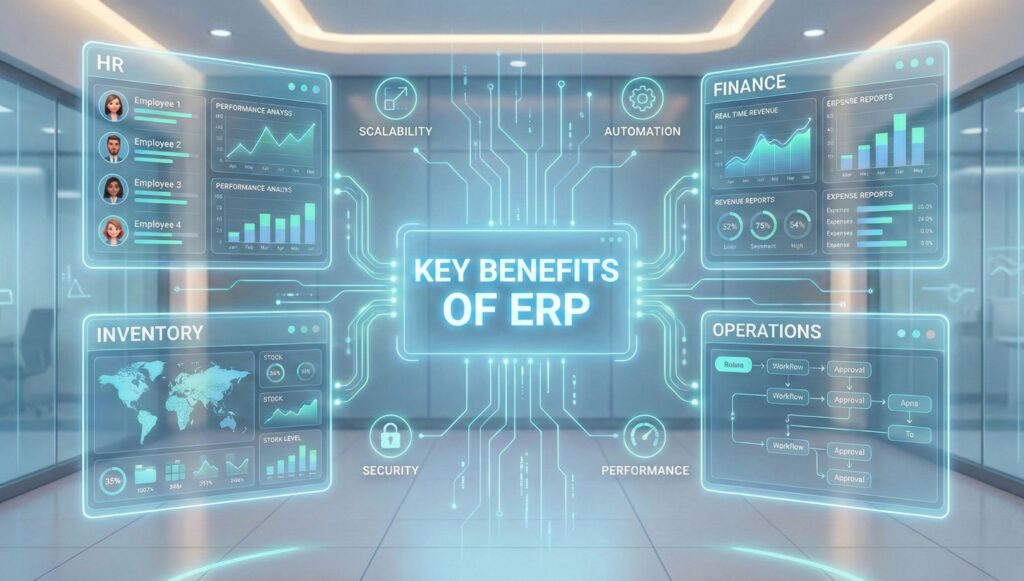
Traditional Software
Tailored to Your Business Processes
The custom ERP systems are built on the way your business works. This implies that the workflows, approvals, reporting, and automation are intended to facilitate daily operations rather than limit them.
Software integration with real-life processes in business results in increased productivity and training reduction,n as well as operational bottlenecks.
Greater Scalability and Future Readiness
The increase in complexities of companies leads to the need to add new users, departments,s and markets to the systems. The custom ERP systems are built keeping in mind the aspect of scalability, whereby the business can add new modules or features without having to reinvent the whole platform.
The conventional ERP programs can be processed more cost-effectively via upgrades or migrations when the scaling boundaries are optimized.
Seamless Integration with Existing Systems
Its custom ERP systems are compatible with the current tools, like CRM systems, accounting software, inventory systems, and third-party APIs. This removes information silos and guarantees uniformity of information among departments.
Conventional ERP solutions can provide integrations, though they are expensive, limited, or rely on outside vendors.
Advanced Automation and Workflow Efficiency
Custom ERP systems have a powerful advantage of automation. The businesses have the ability to automate repetitive processes like order processing, invoicing, reporting, and approvals according to their rules.
Conventional ERP systems are only characterized by simple automation, which might not match the demanding operational requirements.
Improved Data Accuracy and Decision-Making
Real-time access to centralized data with accuracy is made available through custom ERP systems. Dashboards and reports are planned onthe basis of key performance indicators which are of greatest concern to the business.
This helps the management teams to make more informed decisions in a shorter period without using manual reporting or fragmented tools.
Enhanced Data Security and Compliance
Custom ERP systems enable organizations to establish security measures, as per industry standards and internal rules and regulations. Modifications can be precisely made on access levels, data encryption, and compliance requirements.
The common ERP applications are based on standard security systems, which are not necessarily compatible with particular compliance or data protection requirements.
Long-Term Cost Efficiency
Even though custom ERP systems can involve greater upfront cost, they can save costs in the long term. It does not involve recurring license fees, upgrades being forced, or payments on unused features.
The conventional ERP software might prove to be costly in the long run as companies pay subscriptions, extensions, and expansion fees.
Industries That Benefit Most from Custom ERP Systems
Custom ERP systems are especially useful in industries that have a complicated workflow and that are very perceptive of operations. These are manufacturing, logistics, healthcare, e-commerce, finance, and SaaS firms.
Dynamism, automation, and real-time intelligence are necessary in such industries to achieve efficiency and competitiveness.
Challenges of Traditional ERP Software
The old-fashioned types of ERP software are not always in a position to cope with the changing business requirements. The usual obstacles are the lack of customization, complicated integrations, and reliance on vendors to update.
These restrictions have the potential to slow, raise costs, and diminish the effectiveness of the system as a whole as the business expands.
When Should You Choose Custom ERP Over Traditional ERP?
Custom ERP systems should be considered by businesses that no longer find the operational complexity or growth supported by off-the-shelf software. The greatest beneficiaries are companies that are venturing into new markets or need complicated integrations.
Custom ERP systems offer a strategic benefit should long-term flexibility, performance, and ROI be major concerns.
How Bytechsol Builds Custom ERP Systems
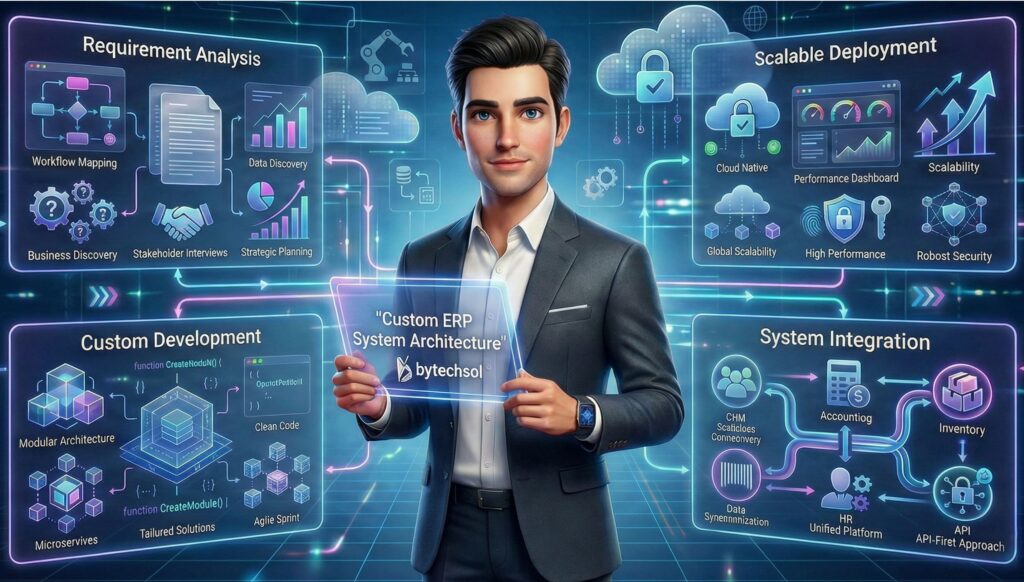
Bytechsol specializes in the design and development of scalable custom ERP systems in accordance with business-specific requirements. The development process is aimed at analyzing the workflow, integrating the system, and further scaling.
We assist companies to move away from inflexible traditional ERP software to tailor-made ERP solutions, which will embrace automation, security, and long-term expansion.
Conclusion
Custom ERP Systems have the distinct benefits of flexibility, scalability, and the ability to gain complete control of activities over traditional software. They can help companies to optimize the working process, enhance safety, and lower expenses in the long term.
Investment in a tailored ERP system is a long-term project that has a calculated value to the organization.