The Ultimate Guide to E-Commerce Website Development
February 18, 2026 • Noor Ul Sabah
E-commerce has totally changed the way of business in the selling of products and services. The customers need multi-site and cross-platform online stores that are fast to load, safe, and beautiful. The evolution of e-commerce websites has, therefore, proved to be a business requirement that can make a business prosperous as opposed to luxurious. Whether you have a new online shop or you are renovating the existing one, understanding the dynamics of the e-commerce development will help you to make the right choices.
This is a complete guide to all the important aspects of the technology of e-commerce website development, including platforms, principles of online store development, core features, costs, and best practices that can help companies develop on a sustainable basis.
What Is E-Commerce Website Development?
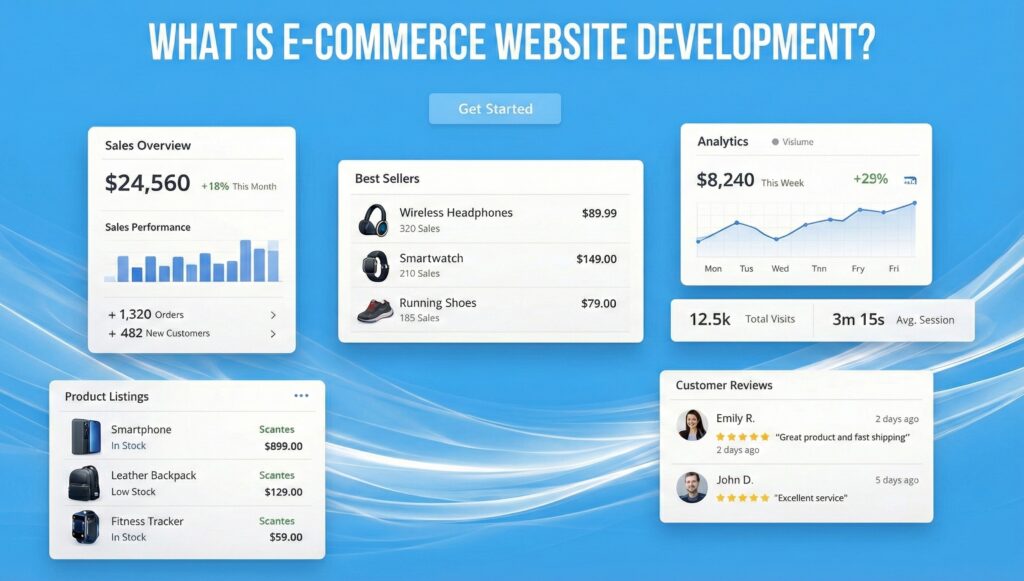
Development of e-commerce websites is the act of creating an online platform where businesses are able to sell products or services over the internet. It entails front-end design, back-end development, database management, integration of a payment gateway, and implementation of security. The e-commerce sites, in contrast to the traditional ones, have complicated processes. An example is that they maintain product catalogs, and inventory and customer data are stored safely. This makes development a matter that requires proper planning, technical skills, and emphasis on user experience.
Moreover, the current e-commerce solutions focus on speed, mobile responsiveness, and personalisation. These are important in terms of customer satisfaction and customer conversion.
Why E-Commerce Website Development Matters for Businesses
An established e-commerce site is a direct influence on the revenue, brand power, and consumer confidence. Thus, companies that focus on quality development acquire a high level of competitiveness in the online market.
Key Benefits of E-Commerce Website Development
- First, it allows companies to market goods twenty-four hours a day without geographical restrictions.
- Second, it minimizes the cost of operations for physical store maintenance.
- Additionally, it gives important customer information via analytics and tracking applications.
- It also enhances online credibility and visibility of the brand.
- Lastly, it facilitates growth when the business grows.
With the ever-increasing online shopping in the world, the businesses that fail to incorporate a robust e-commerce segment risk losing a certain number of customers to their competitors.
Types of E-Commerce Websites
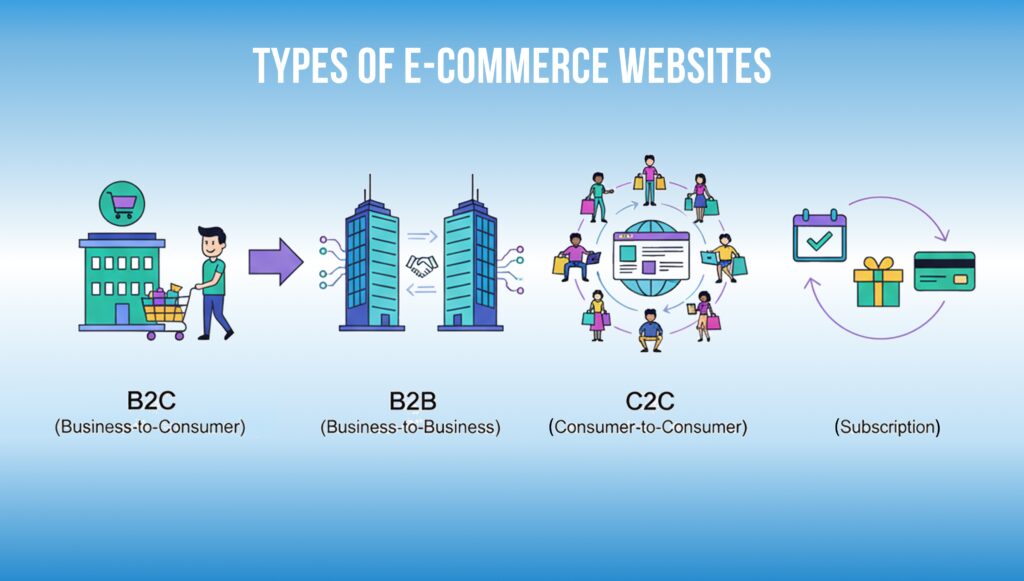
One should get to know various e-commerce models before commencing development. All the models have their purpose and target audience.
Business-to-Consumer (B2C)
Products go to the final customers via B2C e-commerce websites. This could be fashion stores, electronics shops, and grocery platforms. They place much emphasis on internet store design, quick shopping,g and smooth navigation on these websites.
Business-to-Business (B2B)
B2B e-commerce sites are used by the business, not by individuals. They also usually have a bulk ordering, custom pricing, quotation system, as well as a role-based access system. Hence, they need higher functionality.
Consumer-to-Consumer (C2C)
C2C sites enable people to market products to fellow users. Places such as these require robust security platforms, user authentication, and review controls to build trust.
Subscription-Based E-Commerce
Recurring products or services are provided on subscription-based platforms. As a result, they need quality billing systems, automated payments, and customer account management systems.
Key Features of a Successful E-Commerce Website
An effective e-commerce site needs to be user-friendly and efficient on the backend. Aestheically appealing store can still be unable to convert visitors without appropriate features.
User-Focused Features
- Simple navigation of products and sophisticated search.
- Good quality of product pictures and description.
- Quick, reliable, and hassle-free checkout systems.
- Multiple payment options
- Mobile design is fully responsive.
Admin-Focused Features
- Inventory and order control.
- Customer information and CRM.
- Sales analytics and reporting.
- Promotions, marketing tools, and discounts.
These features, when combined with each other,r provide a seamless purchasing experience and also give businesses complete control of the operations.
E-Commerce Website Development Process
Understanding the development process helps businesses plan budgets, timelines, and resources effectively.
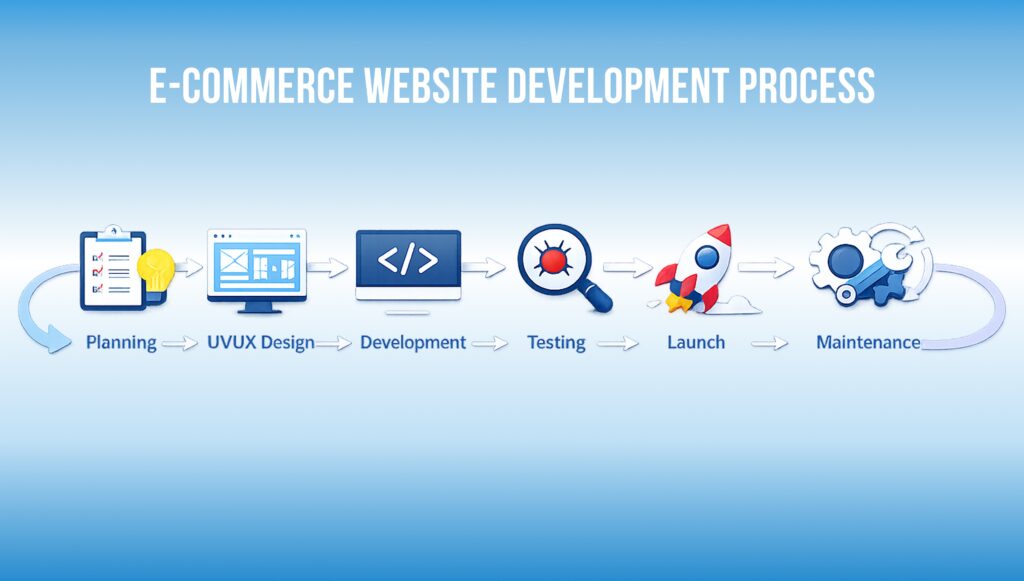
Step 1: Requirement Analysis
The first step involves the determination of business objectives, target audience, and desired features. Hence, proper documentation prevents misunderstanding in the future.
Step 2: Platform Selection
Scalability and performancedepends on the selection of the appropriate platform. Shopify, WooCommerce, Magento, and custom-built are the most popular.
Step 3: UI/UX Design
Designers create wireframes and prototypes to map the user journey. The businesses are therefore able to pursue the structure before the commencement of the development.
Step 4: Development and Integration
The frontend and backend are developed by developers who add payment gateways, shipping API, and third-party tools.
Step 5: Testing and Quality Assurance
Testing is a guarantee of a smooth performance. Speed, security, and compatibility between devices and browsers are checked by the developers.
Step 6: Launch and Maintenance
Following the launch, the store is made competitive through continuous updates and security patches, as well as performance improvements.
Choosing the Right E-Commerce Platform
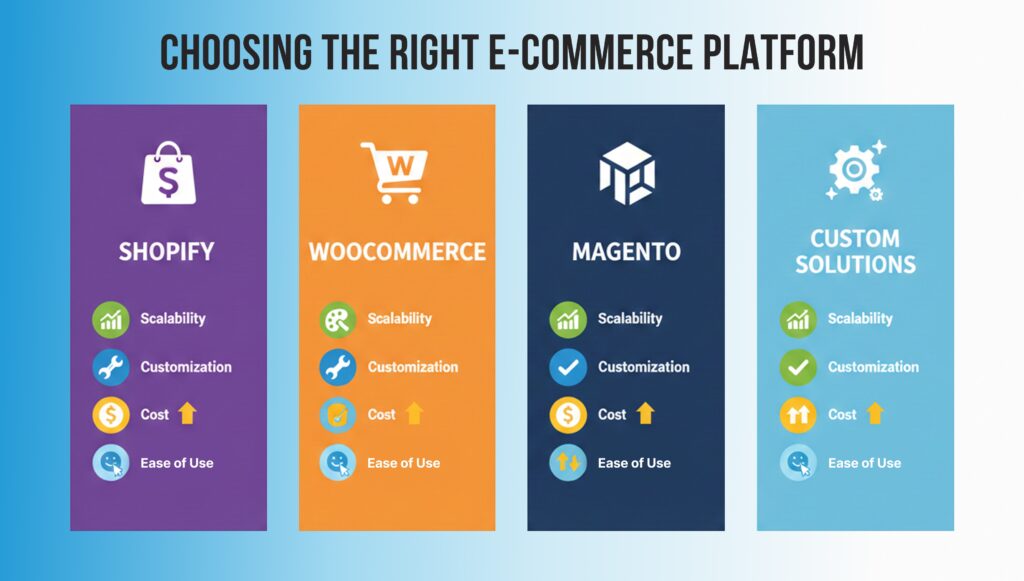
Choosing the right e-commerce system is the key to the successful future of your online company. The failure to have a universal solution is because each business has various objectives, budgets, and technical needs.
So, it is always important to select a platform that meets your immediate and future developmental goals.
Some are based on simplicity and speed,d whereas others are based on flexibility and scalability. Consequently, companies now have to consider carefully features, prices, and customization abilities to make a judgment.
Popular E-Commerce Platforms
Shopify
Shopify is an e-commerce platform that is easy to establish and operate. It is perfect when the startup or small business has to be launched fast without the technical complications. In addition, Shopify providebuilt-inlt hosting, security, and payment integration that make it easy to run a store. Nonetheless, customization can be limited to businesses with sophisticated needs.
WooCommerce
WooCommerce is a strong WordPress Plugin which is flexible and cost-effective. It is more suitable when the company has already installed WordPress and wants to have more control over the online store design. Also, WooCommerce offers numerous themes and mechanisms, which is why it can be used in the expansion of stores. With that said, more practical management is needed in the areas of performance optimization and security.
Magento
Magento is a powerful platform that is used wforlarge-scale and enterprise-level bbusinesses It has superior functions like multi-store management, multi-product catalogs, as well as custom workflows. Hence, it suits well in companies that require high scalability and customization. Nevertheless, the development of Magento needs professional developers andan increased budget.
Custom E-Commerce Solutions
Tailor-made e-commerce solutions will provide total control over functionality, design, and performance. These platforms are designed with business requirements in mind and can also be easily integrated with the existing systems.
This has made them offer unparalleled flexibility and scalability. Even though this would require more initial investment, the custom development will provide long-term value to companies that have special needs.
Payment Gateway Integration and Security
The most important pillar of successful e-commerce solutions is security. Online stores have access to sensitive personal and financial data of their customers. As such, companies should focus on the secure processing of payments to safeguard information.
The conversion rates are directly influenced by a smooth and secure checkout experience. Customers are likely to leave their carts behind in case they do not feel safe or when they experience friction when making payments. Consequently, it is critical to incorporate dependable payment gateways and sanctions.
Essential Security Measures
SSL Certificates
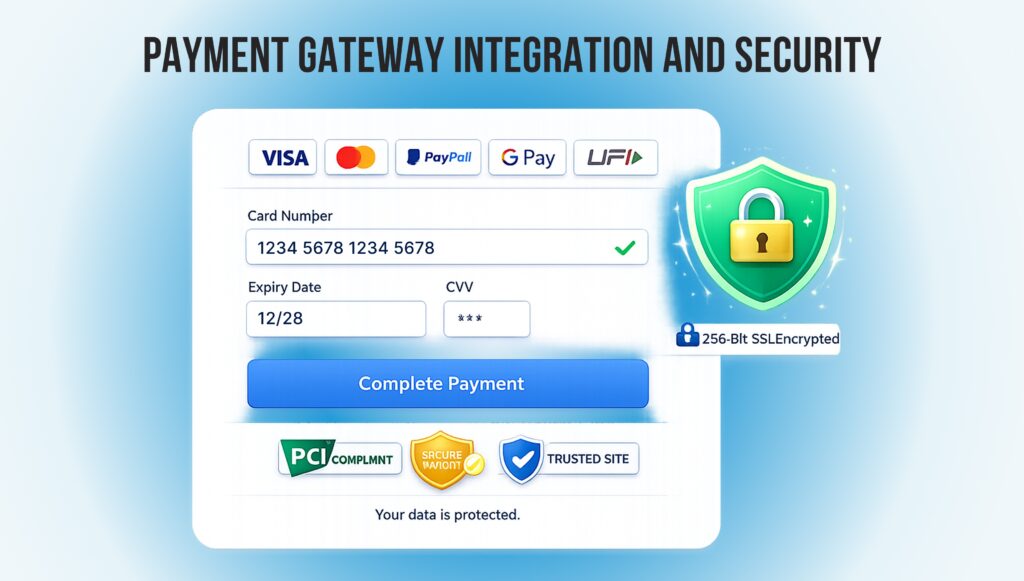
The data between the user and the wwebsiteis encrypted by using the SSL certificates. This encryption does not allow any third-party access and makes the communication secure. In addition, theSSL certificates enhance confidence and lead to improved SEO ranking.
Secure Payment Gateways
Trusted payment gateways such as Stripe, PayPal, and bank integrations protect transactions and reduce fraud risks. Moreover, the presence of various payment methods will enhance the convenience of users and the checkout process.
PCI Compliance
The compliance of the payment card industry (PCI) is a guarantee that the online stores comply with the security standards in processing card data. Thus, the risk of legal problems and data breaches will be minimized by compliance.
Data Encryption
In order to guard customer information stored, data encryption shall safeguard the information against cyber threats. As a result, it protects the data of users even in case of unauthorized access.
These security measures help businesses to gain customer confidence, minimize cart abandonment, and also secure their brand names.
SEO and Performance Optimization for E-Commerce Websites
SEO contributes significantly to making e-commerce websites visible, getting traffic, and sales. Even the best online store can find it difficult to attract customers without being optimized properly. Thus, performance optimization and SEO should be included in the development plan initially.
E-Commerce SEO Best Practices
Optimize Product Pages
Enhance search visibility by using appropriate product title keywords, descriptions, and headings. Further, different product descriptions would prevent the problem of copying content.
SEO-Friendly URLs
Clean and readable URLs improve both user experience and search engine indexing. Therefore, avoid unnecessary parameters and complex structures.
Improve Page Loading Speed
Fast-loading pages reduce bounce rates and increase conversions. Compressing images, using caching, and optimizing code significantly improve performance.
Add Structured Data
Formatted information aids search engines in comprehending product information, including price, availability, and reviews. Therefore, it enhances rich snippets in search results.
Optimize Images
Reduced and meaningful naming of imagesenhancese faster loading and visibility of image search.
In addition, performance optimization improves the user experience, dwell time, and the ranking of the pages in the entire SEO.
Common Mistakes to Avoid in E-Commerce Development
Any tiny misinformation in the development of the e-commerce websites will spoil the user experience and sales. Hence, it is best to discover and prevent these problems at their initial stages to create sustainable and productive online shops.
Mistakes to Watch Out For
Complicated Checkout Process
The long or complicated checkout process is annoying to users, and it causes cart abandonment. Checkout is simplified to enhance conversions.
Poor Mobile Optimization
With numerous users shopping using mobile devices, an unresponsive design will lead to the loss of sales. Hence, the mobile-first optimization is required.
Slow Page Speeds
Websites that are slow to load cause less engagement and high bounces. Streamlining of performance makes the shopping process smooth.
Weak Security Measures
Absence of adequate security undermines credibility and puts companies at risk of information theft. High security is an aspect that cannot be ignored.
Ignoring SEO Fundamentals
Online stores cannot become visible without the help of SEO optimization. Hence, the incorporation of SEO in the development should be made.
These are some of the pitfalls that should be avoided to enable businesses to provide a comfortable, safe, and lucrative e-commerce experience to the users.
How Bytechsol Helps with E-Commerce Website Development
We are experts at developing secure, scalable, and high-performing e-commerce websites at Bytechsol. Our team provides business-specific e-commerce solutions.
We bring together the current online store design, sound development practices, and searchengine-friendlyy architecture to bring business to grow with confidence. Bytechsol delivers the results whether you need to be in a startup store or an enterprise platform.
Final Thoughts
The development of e-commerce websites does not just stop at the construction of an online store. It demands strategy, design, technology, and constant optimization. Businesses should therefore have a long-term approach to it.
With an appropriate platform, a keen online store design, and scalable e-commerce solutions, you can build a digital frontier that will help propel growth and customer loyalty.
It is time to make it right in case you are planning to launch or upgrade your e-commerce site.